


Evaluating the NXP i.MX95 Platform for Edge AI and Embedded Systems
As embedded systems evolve toward increasingly intelligent edge devices, selecting the right processing platform becomes a strategic decision. The NXP i.MX95 family represents a new generation of application processors designed to address the growing demand for machine learning, multimedia processing, and real-time performance at the edge.
This blog provides a decision-focused overview of the NXP i.MX95 platform based on RidgeRun’s exploration of the platform, highlighting the capabilities that matter most when evaluating a hardware/software ecosystem for your next embedded product.
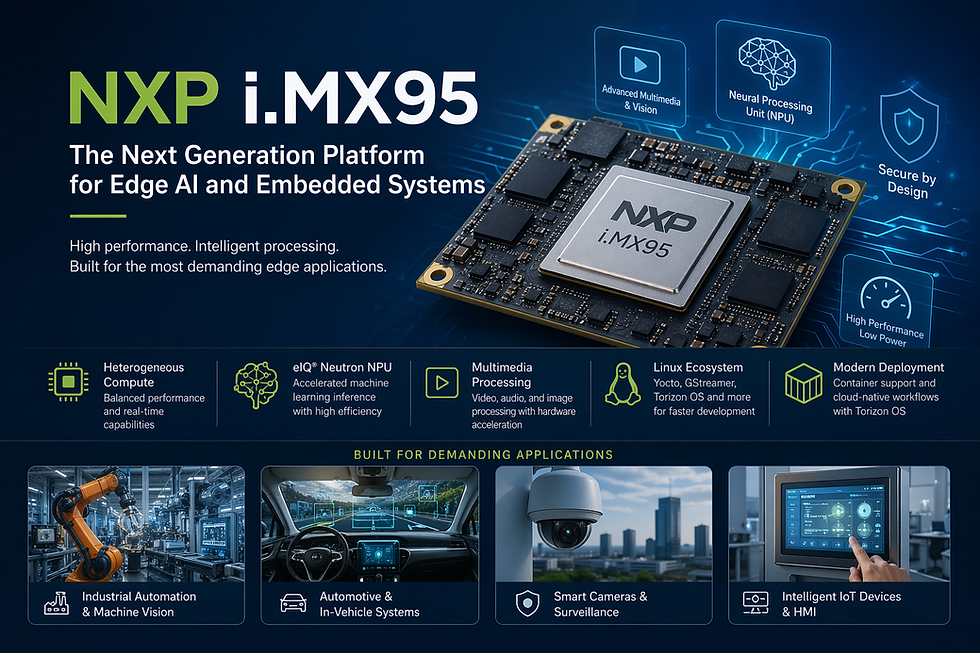
A Platform Built for the Next Generation of Edge Applications
The NXP i.MX95 platform is positioned for applications where machine learning, high data throughput, and energy efficiency are core requirements. Modern edge workloads—such as driver monitoring, object detection, industrial inspection, and speech-to-intent systems—require significant computational resources that traditional CPU-centric architectures struggle to deliver efficiently.
To address this, the i.MX95 integrates heterogeneous compute elements and dedicated accelerators, enabling:
Efficient local AI inference
Reduced reliance on cloud processing
Improved latency and responsiveness
Better power-performance balance
This makes the platform particularly relevant for industrial automation, automotive systems, and intelligent IoT devices.
Key Architectural Differentiators
Dedicated Neural Processing Unit (NPU)
A defining characteristic of the NXP i.MX95 is the inclusion of the eIQ® Neutron Neural Processing Unit (NPU), designed specifically for accelerating machine learning workloads.
From a decision-making standpoint, this has several implications:
Offloads AI inference from CPU/GPU resources
Improves throughput for neural network execution
Enhances power efficiency for edge deployments
The NPU supports modern neural network types and integrates with a software stack that simplifies deployment and validation of machine learning models.
Heterogeneous Compute Architecture
The i.MX95 combines multiple processing cores to balance performance and determinism:
Multi-core Arm Cortex-A CPUs for general-purpose processing
Real-time microcontroller-class cores for deterministic tasks
GPU and multimedia accelerators for visual workloads
This heterogeneous architecture allows teams to consolidate workloads that would otherwise require multiple chips, reducing system complexity and BOM cost.
Advanced Multimedia and Vision Capabilities
The platform provides strong support for multimedia and vision processing, including:
Video capture and processing pipelines
Streaming capabilities (e.g., RTSP, UDP)
Audio handling and integration
Hardware-accelerated video processing units (VPU)
These features make the i.MX95 suitable for vision-based systems, such as:
Smart cameras
Industrial inspection systems
Human-machine interfaces (HMI)
Surveillance and monitoring platforms
Software Ecosystem and Development Flexibility
A critical factor for platform selection is the maturity of the software ecosystem. The i.MX95 is supported by widely adopted embedded Linux frameworks and tools, including:
Yocto-Based Development
The RidgeRun guide includes extensive support for Yocto, enabling:
Custom Linux distribution creation
Fine-grained control over system components
Integration of machine learning and multimedia stacks
This is particularly relevant for organizations requiring long-term maintainability and customization.
Torizon OS and Containerization
Support for Torizon OS introduces a modern development paradigm based on containers. This allows teams to:
Deploy applications in isolated environments
Simplify updates and lifecycle management
Align embedded workflows with cloud-native practices
For decision-makers, this translates into reduced development friction and improved DevOps alignment.
GStreamer and Multimedia Frameworks
The platform includes strong integration with GStreamer, enabling rapid development of:
Video pipelines
Streaming applications
Multimedia processing workflows
This reduces time-to-market for applications that depend heavily on video or audio data.
Hardware Ecosystem and Prototyping
The RidgeRun documentation references support for carrier boards such as the Toradex Verdin i.MX95 development platform, which provides:
A ready-to-use evaluation environment
Integration with software stacks and tools
Faster prototyping and validation cycles
This ecosystem approach is important for teams aiming to accelerate early-stage development and proof-of-concept validation.
Target Use Cases
Based on the capabilities outlined in the guide, the i.MX95 is particularly well-suited for:
Industrial automation and machine vision
Automotive edge systems and monitoring
Smart IoT devices with AI capabilities
Multimedia-rich embedded interfaces
The combination of AI acceleration, multimedia support, and real-time processing enables a wide range of edge computing applications.
Continue Reading about NXP i.MX95 platform
Interested in Reaching the Next Level?
Contact us at https://www.ridgerun.com/contact.


