


Getting Started with Qualcomm Dragonwing 9075 EVK for Embedded Multimedia Development

Qualcomm Dragonwing IQ-9075 is an embedded SoC platform designed for demanding edge AI, multimedia, robotics, drone, and industrial vision applications. As part of Qualcomm’s Dragonwing portfolio, it targets industrial, enterprise, and embedded systems that require high-performance processing, power-efficient AI, advanced connectivity, and long-term deployment support.
About the board
The Dragonwing IQ-9075 platform delivers high-compute, power-efficient AI performance with thermal junction support from -40°C to 115°C. It supports Qualcomm Linux software and Ubuntu.
The IQ-9075 SoC is offered in two configurations:
50 TOPS variant requiring two PMICs
100 TOPS variant requiring four PMICs
It is equipped with:
CPU: 8x ARM cores, Qualcomm® Kryo™ at > 2.1 GHz
NPU: Qualcomm® Hexagon™ at 50 or 100 TOPS
GPU: Adreno™ 663
RAM: Up to 36 GB of LPDDR5
Encoding: 2x 4K @ 60 fps
Decoding: 4x 4K @ 60 fps
Cameras: Up to 16
Yocto compatibility
The Qualcomm Linux release is built on the principles of the Yocto Project to help you further customize Qualcomm Linux. Qualcomm Linux 2.0 RC1 is based on the Yocto master branch.
Qualcomm Linux offers two reference images:
qcom-multimedia-image includes upstream software components, and the kernel from the qcom-6.18.y branch of the Qualcomm Linux kernel.
qcom-multimedia-proprietary-image includes Qualcomm value-added software, and the kernel from the qcom-6.18.y branch of the Qualcomm Linux kernel.
Ubuntu Features
The available image for the Dragonwing IQ-9075 EVK board is provided by Canonical for either server or desktop support. This includes the Kernel Linux 6.8 version, systemd and APT package manager support. Also it has the following features:
System and Runtime: Power management, container orchestration, SSH, SCP, ZRAM enablement, remote proc.
Graphics Support (through GPU Adreno): 3D rendering, OpenGL ES 3.1, EGL 1.4, Vulkan 1.1, OpenCL support for Wayland/Weston, UBWC compression.
Multimedia: Hardware acceleration processing, playback, recording, video concurrency.
Camera: High Frame Rate (HFR), Lens Distortion Correction (LDC), Lens Shading Correction (LSC), Noise Reduction for Snapshot/Video, ML-based Face Detection in the camera backend, single and multi-camera support, Auto White Balance (AWB), Auto-Exposure Compensation (AEC), face detection using the ML backend.
DSP: fastrpc support to manage DSP, Qualcomm Hexagon workload enablement.
Computer Vision: FastCV, OpenCV on CPU only.
SDKs: QIMP, QIRP.
Audio: ALSA, PipeWire, playback and recording, 2x I2S speaker amplifiers, 1x I2S microphone.
Display: DSPP, SSPP, HDR, GBM, Pixman rendering, DisplayPort over Type-C, Native DP, eDP interface.
Security: User data protection with FBE, PKCS#11-based secure key management, QTEE, Global Platform, Secure File System, SMCInvoke and QseeComCompat, QCrypto, PRNG, Public Sec Tools (Secure Boot, UEFI Secure Boot not supported).
Multimedia Support
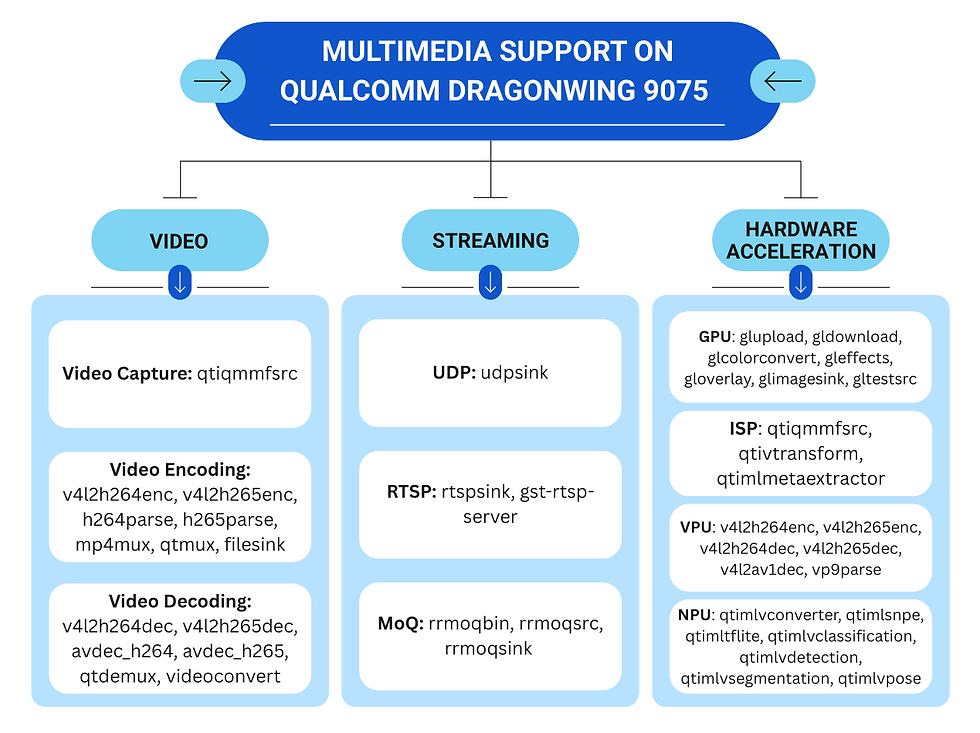
The following diagram provides a high-level overview of the multimedia support available on the Qualcomm Dragonwing 9075 platform. It organizes the multimedia stack into three main areas: Video, Streaming, and Hardware Acceleration.
With video, the board includes elements for capture, encoding, and decoding. This represents the basic building blocks needed to acquire video from a source, process it, compress it, decode it, or prepare it for storage and playback.
The streaming section groups the network-oriented media features for sending or receiving multimedia content over different streaming protocols like UDP, RTSP and MoQ.
The Hardware Acceleration section highlights the platform accelerators used to improve multimedia performance. It separates acceleration by processing unit, including the GPU for graphics-related operations, the ISP for camera and image processing, the VPU for video codec workloads, and the NPU for AI-based multimedia processing.
Security Features
The Dragonwing IQ-9075 security features are available across two software images: the Ubuntu 24.04 image provided by Qualcomm and the Qualcomm Linux 1.8 Yocto distribution. Some features are supported in both images, while others are available only in Yocto. Qualcomm Linux 1.8 is used as the reference version for the security guides because the newer 2.0-rc release does not yet support all available security features.
For Ubuntu, the available features include user data protection, PKCS#11-based key management, QTEE, GlobalPlatform, Secure File System, SMCInvoke and QSEEComCompat, QCrypto, PRNG, and public security tools. However, Secure Boot and UEFI Secure Boot are not supported for the Ubuntu image.
For the Yocto Qualcomm Linux 1.8 distribution, the available security features are more complete. In addition to user data protection, key management, QTEE, GlobalPlatform, Secure File System, QCrypto, and public security tools, Yocto supports Secure Boot, UEFI Secure Boot, storage encryption, debug security, the QCOMTEE driver, and the Qualcomm Hypervisor.
RidgeRun Products for Qualcomm Dragonwing 9075
RidgeRun offers a variety of products compatible with Qualcomm's Dragonwing 9075 EVK for multimedia and GStreamer-based applications. The following products have been tested on the board:
GstD: Control pipelines through console commands.
GstSEI: Extract, insert and process metadata in video streams.
RTSPSink: Publish multimedia through RTSP.
Prerecord: Buffer media before a trigger event occurs.
Interpipes: Connect independent pipelines.
GstPTZR: Apply digital pan, tilt, zoom and rotation operations to video.
QtOverlay: Render Qt or QML-based graphics on top of video.
GstISP: Image signal processing for Gstreamer pipelines.
RidgeRun Video Stabilization Library: Reduce unwanted camera motion.
Media over QUIC: Stream media through MoQ protocol.
RidgeRun’s Qualcomm Dragonwing Technical Guide brings these topics together in one developer-oriented resource. It covers the platform introduction, IQ-9075 carrier board information, board bring-up, GStreamer usage, multimedia acceleration, and security features that matter when taking an embedded product from evaluation to deployment.


